
Remember when United Airlines dragged a passenger off an overbooked flight in 2017?
One moment. One bad call. And within hours, the damage was everywhere.
The problem wasn’t just the incident.
It was how unprepared the system was to handle it.
The same thing happens in software.
Every company faces bugs, traffic spikes, feature changes, and user complaints. That’s normal. What decides whether a product survives or struggles is the software development technologies working behind the scenes.
Choose the wrong ones, and small issues turn into constant breakdowns.
Choose the right ones, and your product bends without breaking.
That’s why this guide looks at the software development technologies that actually matter in 2026.
What Exactly Are Software Development Technologies?

Software development technologies are the tools and systems that help programmers create software. Just like a carpenter needs a hammer, saw, and drill to build furniture, programmers need their own set of tools to build apps and programs.
These tools include things like:
- programming languages (the actual languages programmers write in)
- Frontend frameworks
- Backend frameworks
- databases (places to store information
- and cloud platforms (powerful computers on the internet that run your apps)
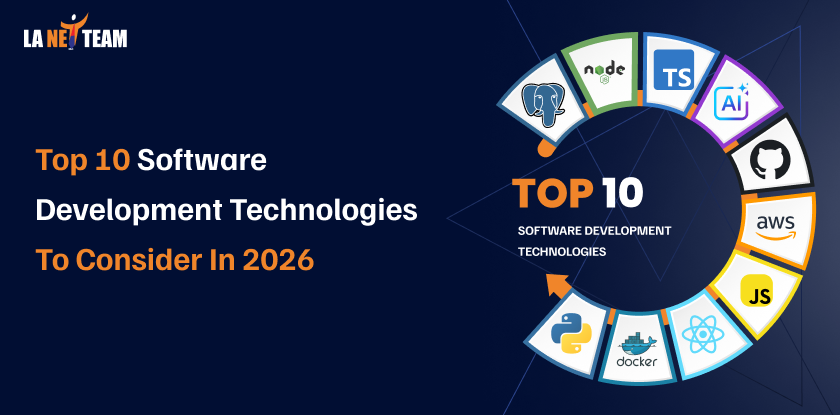
The Top 10 Software Development Technologies You Should Know About in 2026
1. Python (The language everyone can learn)
Let’s start with Python, which is basically the most popular programming language right now.
Python is loved because it’s incredibly easy to read and write. When you look at Python code, it almost reads like regular English sentences. That’s why so many beginners start with Python.
But don’t think Python is only for beginners. Companies use Python for really serious stuff like analyzing huge amounts of data, creating artificial intelligence systems, building websites, and automating boring repetitive tasks.
Did you know
Netflix uses Python to recommend shows you might like. Instagram runs on Python. Even NASA uses Python for scientific calculations.
The best part? Python is free. Anyone can download it and start using it without paying a single penny. Plus, there’s a massive community of Python programmers online, so if you get stuck, you can easily find help.
| What People Use Python For |
|
| Pros |
|
| Cons |
|
2. JavaScript (Making Websites Come Alive)
If you’ve ever been on a website where things move, respond to your clicks, or update without refreshing the page, that’s JavaScript at work.
JavaScript is what makes websites interactive and fun to use. Without JavaScript, websites would just be boring static pages that don’t do anything.
Here’s something cool: JavaScript runs directly in your web browser. That means every single person reading this article already has JavaScript installed on their device. You don’t need to download anything special.
Almost every modern website uses JavaScript in some way. Facebook uses it. YouTube uses it. Your online banking website definitely uses it. If a website feels modern and responsive, JavaScript is probably making that happen.
| What People Use Python For |
|
| Pros |
|
| Cons |
|
3. React (Building Modern User Interfaces)
React is a frontend framework that helps developers build modern and fast-loading user interfaces. It breaks interfaces into small reusable components, making development more efficient.
React was created by Facebook (now called Meta), and it’s designed specifically for building user interfaces – basically, the parts of apps and websites that you actually see and interact with.
What makes React special is how it thinks about building interfaces. Instead of creating one giant complicated page, React lets you break everything down into small reusable pieces called components.
Big companies love React. Netflix uses React for its interface. Airbnb uses React. Dropbox, WhatsApp, and Instagram all use React.
| What People Use Python For |
|
| Pros |
|
| Cons |
|
4. Node.js (JavaScript on the Server)

You already know JavaScript runs in browsers. Node.js took it a step further and made it run on servers, too.
This means developers can use JavaScript not just for what users see, but also for what happens behind the scenes. One language. Both sides. Less confusion. Faster work.
Node.js is great at handling many users at the same time. That’s why it’s used for chat apps, social media platforms, online games, and real-time tools.
Big companies like LinkedIn, Uber, and PayPal rely on Node.js because it stays fast even when millions of users are active together.
| What People Use Python For |
|
| Pros |
|
| Cons |
|
5. TypeScript (JavaScript’s Smarter Cousin)
TypeScript is like JavaScript, but with extra features that help prevent mistakes and make code easier to work with in big projects.
The main thing TypeScript adds is “types” – basically, you have to tell TypeScript what kind of data you’re working with (numbers, text, true/false, etc.). This might sound like extra work, but it actually catches tons of bugs before your code even runs.
Think of JavaScript as a free-flowing chat. Flexible, but messy at times. TypeScript adds clear rules, so everyone understands what’s going on.
Microsoft created TypeScript, and it’s become incredibly popular, especially for large applications. Many companies are switching their JavaScript code to TypeScript because it makes their codebases easier to manage and has fewer bugs.
| What People Use Python For |
|
| Pros |
|
| Cons |
|
6. PostgreSQL (Storing Your Data Reliably)
PostgreSQL, often called Postgres, is a powerful database used to store and manage application data.
If you’re building something like an online store, you need a safe place to keep product details, customer info, orders, and payments. Postgres handles all of that smoothly.
What makes it stand out is reliability. It follows strict rules to protect data, even if something crashes midway. That’s why banks and finance companies trust it.
PostgreSQL has been around since the 1980s, but it’s still actively developed and used by modern companies. Instagram uses PostgreSQL to store billions of photos and user data. Apple uses it. Even the International Space Station uses PostgreSQL for some of its systems.
| What People Use Python For |
|
| Pros |
|
| Cons |
|
7. Docker (Packaging Applications Perfectly)
Docker is one of the most widely used DevOps Tools, helping teams deploy applications faster and more reliably.
Let me explain the problem Docker solves. You know how sometimes a program works perfectly on one computer but breaks on another? That’s because computers have different setups, different versions of software installed, and different settings. It’s a huge headache for developers.
Docker fixes this by putting the app and everything it needs into a container. If Docker is installed, the app runs without issues.
This makes development smoother. What works on a developer’s laptop will work the same on servers. No “it worked on my system” excuses.
| What People Use Python For |
|
| Pros |
|
| Cons |
|
8. Amazon Web Services (AWS) (Computing Power on Demand)
AWS is Amazon’s cloud platform that lets you run apps without owning servers.
Instead of buying costly machines, you rent computing power from Amazon’s global data centers. You use what you need and pay only for that.
AWS offers everything you might need to run an application:
- places to store files, databases
- computing power to run your code
- tools for machine learning
- systems for sending emails
- and hundreds of other services
Big names like Netflix, Spotify, Airbnb, and Reddit rely on AWS because it’s fast, reliable, and built to scale.
| What People Use Python For |
|
| Pros |
|
| Cons |
|
9. Git and GitHub (Saving Your Work and Collaborating)
Git is a tool that keeps track of every change you make to your code. GitHub is a website that uses Git and adds collaboration features on top.
Think of Git like version history for code. You can go back to older versions, see who changed what, and fix mistakes fast.
GitHub takes this further by hosting your code online and making it easy for multiple people to work on the same project. It’s like Google Docs, but for developers. Everyone edits, GitHub merges changes, and nothing gets lost.
That’s why almost every developer uses Git and GitHub. From small teams to huge open-source projects, this is how code gets built.
| What People Use Python For |
|
| Pros |
|
| Cons |
|
10. Artificial Intelligence and Machine Learning Tools

AI and machine learning are so important in 2026 that every developer should understand the basics. They let computers learn from data and make decisions without being explicitly programmed for every case.
Machine learning is the technology that powers things like facial recognition, voice assistants, recommendation systems, and self-driving cars.
The big players here include TensorFlow (created by Google), PyTorch (from Meta/Facebook), and various AI APIs from companies like OpenAI. These tools make it possible to add intelligent features to your applications without being a Ph.D. researcher.
Even small startups can now add powerful AI features to their apps because these tools handle all the complex math and algorithms behind the scenes.
| What People Use Python For |
|
| Pros |
|
| Cons |
|
Why Do These Technologies Matter?
You might be wondering: “Okay, but why should I care about any of this?”
These technologies aren’t just for programmers, they affect everyone because they’re what’s used to build the digital world we all live in.
When you use a mobile app, it was probably built with React Native or Flutter. When you stream a video, it’s likely coming from AWS servers. When you get personalized recommendations, that’s machine learning at work. When a company manages its code, it’s using Git and GitHub.
Understanding these technologies, even at a basic level, helps you:
- Make Better Decisions: If you’re hiring developers or choosing a technical partner, knowing these terms helps you ask the right questions and understand what you’re getting.
- Understand Possibilities: When you know what’s possible with modern technology, you can come up with better ideas for products or improvements to your business.
- Talk to Technical People: Being able to have intelligent conversations with developers and technical teams is valuable in almost any job these days.
- Future-Proof Your Career: Even if you’re not a programmer, having technical literacy is becoming increasingly important in almost every field.
Final Thoughts
Technology will keep changing. That part is guaranteed.
What really matters is choosing tools that are proven, flexible, and easy to grow with. The right technologies save time, reduce bugs, and help teams build faster without chaos.
You don’t need to chase every new trend. Focus on tools that solve real problems and scale with your goals. Pick wisely today, and your software will still make sense in 2026 and beyond.