
The websites you scroll every day….. The apps you tap without thinking…. That smooth animation when you click a button.
None of that happens by accident.
Behind every modern website is a frontend framework doing the heavy lifting, handling speed, design, and the overall user experience when interacting with it.
But here’s the part most people don’t realize. Not every frontend framework is a good choice.
Last year, a startup rebuilt their entire website using a “trending” framework. It looked great in demos. However, once real users arrived, the site became slow, difficult to maintain, and expensive to repair.
Months of work… gone.
This happens because choosing a frontend framework is not about hype. It’s about picking the right tool for the job. So let’s get started with the guide.
What are Frontend Frameworks and why do they matter?
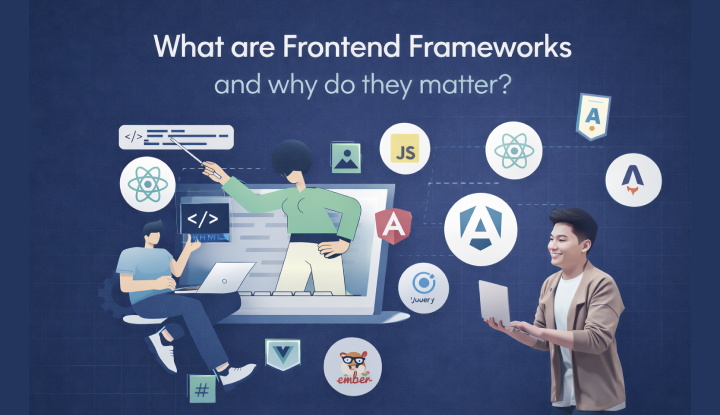
Frontend frameworks are ready-made tools that help developers build the visible part of a website or app faster. They come with built-in features like:
- Page navigation
- Reusable components
- Better control over how data shows on the screen
This saves time and reduces common mistakes. Frontend frameworks work like ready parts used in construction.
Developers don’t write every button, form, or layout from scratch. These frameworks make websites easier to build, easier to manage, and smoother for users.
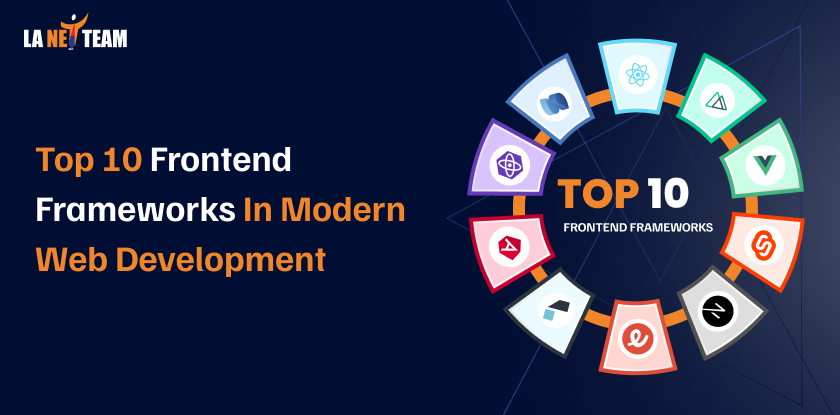
Top 10 Frontend Frameworks for Modern Web Development
1. React
| Created By | Meta (Facebook) |
| Release Year | 2013 |
| Type | JavaScript Library |
| Current Market Share | 40% of developers |
React has dominated frontend development for over a decade and shows no signs of slowing down.
Originally developed to solve Facebook’s challenges with building complex, data-driven user interfaces, React introduced the revolutionary concept of components and the Virtual DOM.
Ideal Use Cases:
- Single-page applications (SPAs) with complex, interactive UIs
- Social media platforms and real-time dashboards
- E-commerce sites requiring dynamic product catalogs
- Applications that need to scale from prototype to millions of users
- Projects where React Native mobile development is planned
Companies Using React:
Facebook, Instagram, Netflix, Airbnb, Uber, WhatsApp, Discord, Dropbox, Tesla
2. Angular
| Created By | |
| Release Year | 2016 (AngularJS was 2010) |
| Type | Full-featured framework |
| Current Market Share | 17–20% of developers |
Angular is Google’s comprehensive framework for building large-scale web applications. Unlike React, Angular provides everything you need out of the box, routing, forms, HTTP client, testing utilities, and more.
It’s opinionated about how applications should be structured, which creates consistency across projects and teams.
Ideal Use Cases:
- Enterprise applications with complex business logic
- Large teams requiring strict code organization
- Applications with long expected lifespans (5-10+ years)
- Progressive Web Apps (PWAs) with offline capabilities
- Projects requiring TypeScript and strong typing
Companies Using Angular:
Google, Microsoft (Office 365), Deutsche Bank, Forbes, Upwork, PayPal, Samsung, BMW
3. Vue.js
| Created By | Evan You (formerly at Google) |
| Release Year | 2014 |
| Type | Progressive framework |
| Current Market Share | 15–18% of developers |
Vue.js combines the best aspects of React and Angular while maintaining simplicity. It’s called “progressive” because you can adopt Vue incrementally, use it for a small widget on a legacy website, or build an entire SPA with Vue’s complete ecosystem.
Best Situations to use it:
- Small to medium-sized applications
- Teams transitioning from jQuery or vanilla JavaScript
- Projects requiring gradual framework adoption
- Rapid prototyping and MVPs
- Interactive UI components on existing websites
- Applications where developer happiness matters
Companies Using Vue:
Alibaba, Xiaomi, Grammarly, GitLab, Adobe, Nintendo, Louis Vuitton
4. Svelte
| Created By | Rich Harris |
| Release Year | 2016 |
| Type | Compiler-based framework |
| Current Market Share | 4–6% (but growing rapidly) |
Svelte takes a fundamentally different approach than other frontend frameworks. Rather than shipping a heavy framework library, this approach turns components into clean JavaScript during the build process.
The result is smaller files, faster loading, and smoother performance in the browser. This results in smaller bundle sizes and faster runtime performance.
Ideal Use Cases:
- Performance-critical applications
- Projects with strict bundle size requirements
- Real-time applications requiring instant updates
- Interactive data visualizations
- Embedded widgets and components
- Developers who value clean, minimal code
Companies Using Svelte:
The New York Times, Apple, Spotify, Philips, GoDaddy, Chess.com
5. Next.js
| Created By | Vercel |
| Release Year | 2016 |
| Type | React-based meta-framework |
| Current Market Share | Used in 35% of React projects |
Next.js is a web framework used to build fast and reliable websites using React. It adds useful features like loading pages faster, creating pages in advance, and building backend APIs, all without extra setup.
Because of this, many developers now use Next.js as the default way to build React applications.
Best Situations to use it:
- SEO-critical applications (e-commerce, marketing sites)
- Full-stack applications with API requirements
- Applications requiring both static and dynamic content
- Projects needing optimal performance and Core Web Vitals scores
- Startups wanting to move fast with excellent DX
Companies Using Next.js:
TikTok, Twitch, Hulu, Nike, Uber, Target, Notion, Auth0
6. Nuxt.js
| Created By | Nuxt team |
| Release Year | 2016 |
| Type | Vue-based meta-framework |
| Current Market Share | Used in 25–30% of Vue projects |
Nuxt.js does for Vue what Next.js does for React, it provides server-side rendering, static site generation, and a complete application framework with routing, state management, and more.
Nuxt 3’s Nitro engine provides server-side functionality with excellent performance and supports deployment to various hosting platforms, including serverless environments.
Ideal Use Cases:
- SEO-focused Vue applications
- Static websites with dynamic capabilities
- E-commerce platforms built with Vue
- Content-heavy sites require good performance
- Teams are already invested in the Vue ecosystem
Companies Using Nuxt:
Upwork, LG, GitLab, Ecosia, Roland, Nespresso
7. Solid.js

| Created By | Ryan Carniato |
| Release Year | 2021 |
| Type | Reactive framework |
| Current Market Share | 2–3% (rapidly growing) |
Solid.js is a frontend framework used to build fast and responsive user interfaces. It looks and feels similar to React, so it’s easy for developers to learn.
The big difference is how it updates the screen. Solid.js updates only the exact parts that change, instead of reloading or rechecking everything. This makes apps run extremely fast.
Because of this smart update system, Solid.js is known for top performance while still being simple to work with.
Best Situations to use it:
- Apps where speed really matters
- Tools where many users work together at the same time
- Dashboards and charts that update data often
- Apps where small changes happen again and again
- Projects where even a tiny delay feels too slow
8. Ember.js
| Created By | Ember Core team |
| Release Year | 2011 |
| Type | Full-featured opinionated framework |
| Current Market Share | 2–4% of developers |
Ember.js is a frontend framework that gives you a clear way to build web applications from day one.
It comes with built-in rules about how files, code, and features should be organized. This helps teams avoid confusion and keep projects clean as they grow.
Even though it’s not as trendy as React or Vue anymore, Ember is still trusted by many companies. It works best for large, long-term projects where stability, structure, and teamwork matter more than chasing new trends.
Best Situations to Use Ember.js
- Big business applications with many features
- Projects that will run for many years without frequent changes
- Teams that like clear rules and fixed ways of working
- Apps that handle a lot of data and complex workflows
- Projects that benefit from Ember’s built-in data handling system
Companies Using Ember:
LinkedIn, Twitch (legacy parts), Square, Heroku, Discourse
9. Preact
| Created By | Jason Miller (now at Google) |
| Release Year | 2015 |
| Type | Lightweight React alternative |
| Current Market Share | 3–5% of developers |
Preact is a small and fast tool for building website interfaces. It works almost the same way as React, so developers don’t need to learn anything new.
The big difference is size. Preact is much lighter, which means websites load faster and feel smoother. It’s a great choice when speed matters, and you want to keep your app simple and quick.
Ideal Use Cases:
- Performance-critical applications with strict size budgets
- Embedded widgets on third-party sites
- Progressive web apps focused on mobile performance
- Projects replacing jQuery with a modern framework
- Applications targeting emerging markets with slower internet
Companies Using Preact:
Uber, Lyft (some components), Etsy (some features), Grammarly
10. Alpine.js
| Created By | Caleb Porzio |
| Release Year | 2019 |
| Type | Lightweight JavaScript framework |
| Current Market Share | 2–3% of developers |
Alpine.js is a very simple tool that helps add small interactions to your website.
It lets you make buttons, dropdowns, forms, and small UI actions work using tiny bits of JavaScript written directly in HTML. There’s no heavy setup and no complex structure to learn.
Alpine.js is best when you don’t need a full framework. Just clean HTML with a little smart behavior to make pages feel alive.
Ideal Use Cases:
- Websites built mostly on the server that need a little interactivity
- Projects using WordPress, Laravel, Rails, or Django
- Marketing sites with simple clicks, toggles, or forms
- Small projects where heavy frameworks feel too much
- Teams that don’t want deep JavaScript complexity
- Sites that work fine without JavaScript but get better with it
Companies Using Alpine:
GitHub (some features), smaller companies and agencies, and Laravel ecosystem companies
Final Thoughts
There’s no such thing as the perfect frontend framework. Some are faster… Some are easier to learn… Some are better for large, complex projects.
What really matters is choosing a framework that fits your project, your team, and your long-term goals. Every great website you admire today started with broken layouts, slow pages, and confusing code.
Use this list of the Top 10 Frontend Frameworks in Modern Web Development as a starting point, not a rulebook. That’s how real web developers grow, not by waiting for the “best” choice, not by quitting when things get tricky.