If you’re just starting with backend development, this might sound familiar…
You’ve learned some basics, watched a few tutorials, and now you’re stuck thinking, “Which framework should I start with?”
The problem isn’t your interest. It is because of too many choices.
Some frameworks look beginner-friendly, but end up making simple things confusing. That’s why choosing the right one early matters.
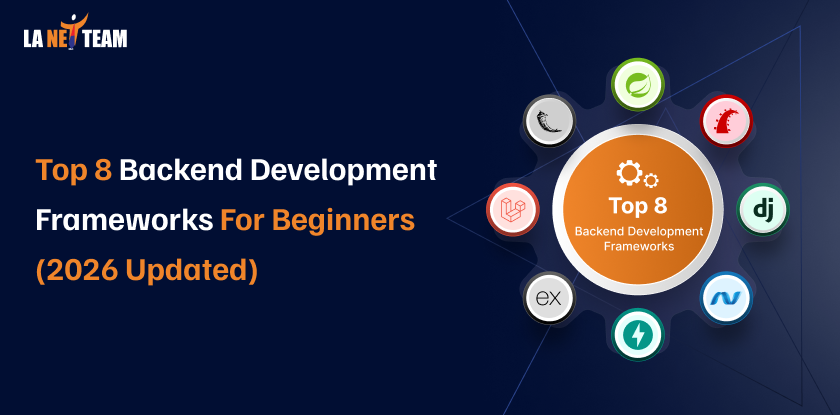
In this guide, we’ve picked the Top 8 Backend Frameworks for Beginners for building real projects without feeling overwhelmed.
What Are Backend Frameworks and Why Do They Matter?
Before we jump into our list, let’s quickly understand what backend frameworks actually are.
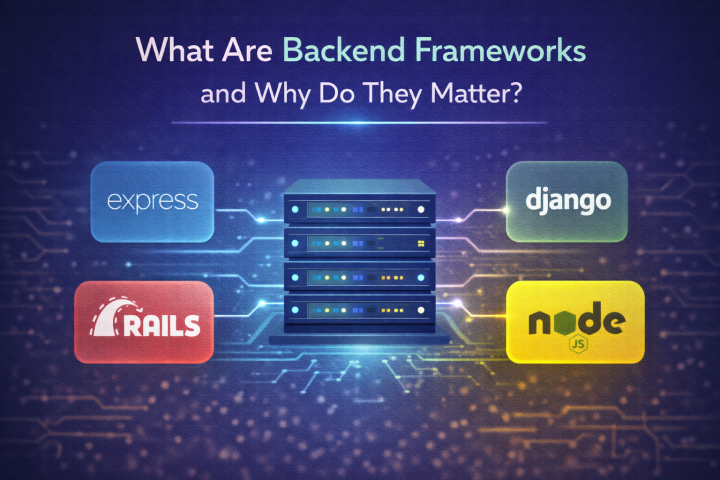
Backend frameworks are tools that help you build the “engine” of a website. They handle things like user login, databases, APIs, security, and server logic, so you do not have to build everything from zero.
Think of them as ready-made building blocks. You focus on the idea. The framework handles the heavy lifting.
Why do they matter?
Because they save time, reduce mistakes, and keep apps secure. In 2026, teams using backend frameworks ship faster, scale easily, and face fewer security issues than those building everything from scratch.
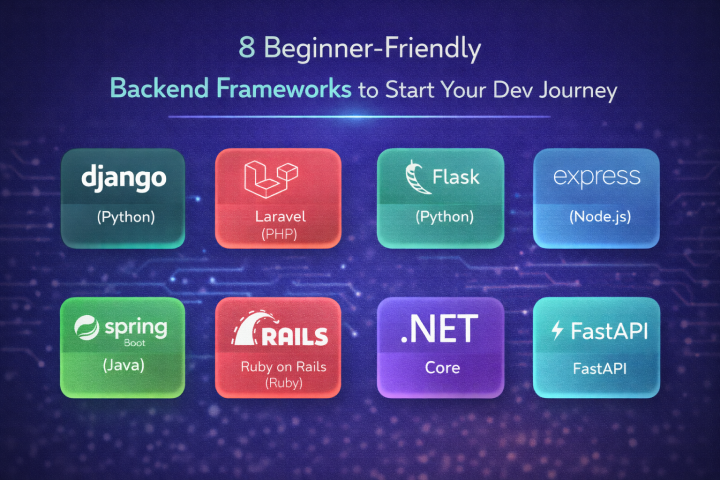
8 Beginner-Friendly Backend Frameworks to Start Your Dev Journey
1. Django (Python)
Best for: Django is ideal for beginners who know Python and want to build a project requiring rapid development with strong security.
Django has been around since 2005 and has grown stronger over the years. It has around 68,000 stars on GitHub, showing how widely it is used.
Django follows a “batteries included” approach. It already gives you an admin panel, user login, database handling, and strong security. You do not have to build these from scratch.
This is why developers say Django is fast to build with. You can create complex apps in less time because many things are handled for you.
Key features
- Clean structure
- Ready admin panel
- Strong security by default
- Easy database work
2. Laravel (PHP)
Best for: Laravel is great for beginners who know PHP and want to build real web apps like SaaS tools, APIs, e-commerce sites, or CMS platforms.
Laravel has consistently been one of the most loved backend frameworks. According to GitHub, Laravel has 82,400 stars, making it one of the most starred repositories in the backend frameworks category.
What makes Laravel special is its elegant syntax. PHP has a reputation for being messy, but Laravel brings modern programming practices to PHP development.
Key features
- Easy login and user access features.
- Simple database handling with Eloquent.
- A strong Laravel ecosystem.
3. Flask (Python)
Best for: Flask is ideal for beginners to learn backend basics, build APIs, small web apps, or quickly prototype ideas using Python.
Flask was created as an April Fool’s joke that became so popular it evolved into a genuine framework.
According to GitHub, Flask has over 70,500 stars, indicating widespread adoption across various industries. Flask is classified as a microframework because it doesn’t require specific tools or libraries, it’s minimal by design.
The lightweight nature of Flask makes it incredibly beginner-friendly. You can see and understand every piece of your application because Flask doesn’t hide complexity behind abstractions.
Key features
- Flask is beginner-friendly and simple.
- Create apps in under ten lines.
- Extensions add database and authentication.
- The modular approach teaches app structure.
- Built-in server shows clear errors.
4. Express.js (Node.js)
Best for: Express.js is ideal for JavaScript users who want to quickly build APIs, real-time apps, microservices, or backends for single-page applications.
Express.js is a simple Node.js framework that many JavaScript developers trust. It is popular on GitHub and used by companies to build reliable backends.
What makes Express.js stand out is its simplicity. It does not force rules on how you build. You get full control.
If you already know JavaScript, Express is easy to learn. You can build a basic API in minutes. As your app grows, Express grows with you. It is fast, handles many users at once, and works well for real-world projects.
Key features
- Easy to scale
- One language advantage
- Simple middleware system
- Huge npm ecosystem
5. Spring Boot (Java)
Best for: Spring Boot suits Java beginners aiming for enterprise apps, microservices, and high-paying backend roles. Steeper learning curve, but great career opportunities.
Spring Boot is Java’s most popular backend framework, powering enterprise applications worldwide. It simplifies Java application development by providing opinionated defaults and auto-configuration. Companies like Intuit, Zillow, and Netflix use Spring Boot for mission-critical applications.
Java has a reputation for verbosity, but Spring Boot reduces boilerplate code significantly. The framework handles configuration automatically, letting you focus on business logic rather than setup.
Key features
- An embedded server runs apps easily
- Spring Data handles database access
- A mature ecosystem solves most problems
6. Ruby on Rails (Ruby)
Best for: Rails is perfect for beginners who want to build MVPs, SaaS apps, e-commerce sites, or learn web development quickly.
Ruby on Rails, or just Rails, is great for beginners who want fast, clean, and productive development.
Rails follows “convention over configuration,” so you don’t have to set up everything manually. It handles repetitive tasks automatically, letting you build apps much faster.
Big companies like GitHub, Shopify, Airbnb, and Basecamp use Rails, showing it works for both small projects and large-scale applications.
Key features
- Rails guides beginners with best practices
- Standard structure reduces decision fatigue
- Generator commands create files automatically
- Active Record simplifies database work
7. ASP.NET Core
Best for: ASP.NET Core is great for beginners using C# in the Microsoft ecosystem. Ideal for building APIs, cloud apps, and enterprise projects.
ASP.NET Core represents Microsoft’s commitment to open-source, cross-platform development. Unlike older .NET frameworks, limited to Windows, ASP.NET Core runs on Windows, macOS, and Linux.
This flexibility makes it accessible to all developers regardless of their operating system.
The framework provides exceptional performance, often ranking among the fastest backend frameworks in benchmarks.
Microsoft’s investment in ASP.NET Core means cutting-edge features, excellent documentation, and long-term support.
Key features
- Built-in authentication and authorization
- Beginner-friendly documentation and resources
- Includes MVC and Web API features
8. FastAPI
Best for: FastAPI is great for beginners focused on APIs, microservices, async apps, or machine learning APIs.
FastAPI is a new but popular Python framework, built for fast, modern, production-ready APIs. Launched in 2018, it uses Python features like type hints and async/await for speed and ease.
It also auto-generates interactive API documentation, letting you test endpoints in the browser, perfect for beginners learning quickly.
Key features
- FastAPI is as fast as Node.js and Go
- Automatic data validation saves beginners time
- Async support enables concurrent apps easily
How to start learning Backend frameworks the simple way? (Free resources)
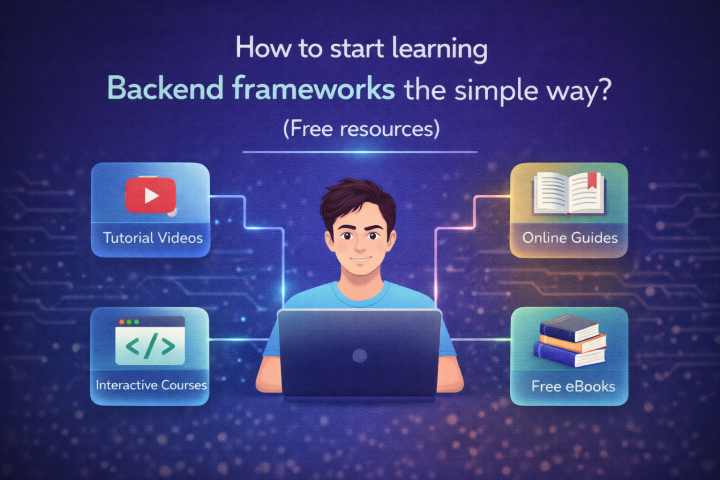
The great news? All these backend frameworks have excellent learning resources available in 2026.
1. Official Documentation
Every framework on this list has comprehensive official documentation.
- Django → Django Official Docs + Django Girls Tutorial (free and beginner-focused)
- Laravel → Laravel Documentation (written like a step-by-step guide)
- FastAPI → FastAPI Docs with interactive examples you can run instantly
- Express.js → Express Official Guide (short and practical)
Start with official docs, they’re free and authoritative.
2. Online Learning Platforms
You can learn a lot without spending money.
- Youtube Channels like Traversy Media, Net Ninja, and freeCodeCamp have full backend framework playlists.
- freeCodecamp Offers free backend tutorials and full-length courses with practice projects.
- Official Tutorials Django Girls, Laravel Bootcamp, and FastAPI tutorials are all free and well-structured.
3. Community Support
Join framework-specific communities on Discord, Reddit, and Stack Overflow. Django, Express.js, and Laravel have particularly active, welcoming communities ready to help beginners. Don’t underestimate the value of community support when you’re stuck.
4. Practice Projects
The best way to learn backend frameworks is by building real projects. Start with a simple REST API, then build a blog platform, then tackle something more complex like an e-commerce site or social network. Each project teaches new concepts and solidifies your understanding.
Real-World Usage: Backend Frameworks Powering the Web in 2026
If you’re wondering, ‘Are these frameworks actually used in real life?’ The answer is ‘Yes’.
- Django runs Instagram, which handles billions of users every day. Companies like Spotify, Pinterest, and even NASA use Django because it is secure, stable, and reliable.
- Laravel powers websites for 9GAG, Laracasts, and Invoice Ninja. Agencies prefer it because it helps build business websites quickly and neatly.
- Flask is perfect when you need something lightweight without extra features. Companies like Pinterest, LinkedIn, and Netflix use Flask for small services and internal tools.
- Express.js is built on JavaScript, which makes it easy for startups to move fast. That is why companies like Netflix, Uber, and PayPal use it.
- Spring Boot is common in large enterprises. Banks, hospitals, and big corporations use it because it is secure and powerful. It is built for serious, long-term systems.
- Ruby on Rails helped many startups grow in their early days. Companies like GitHub, Shopify, and Basecamp started with Rails.
- ASP.NET Core is used heavily in the Microsoft ecosystem. Platforms like Stack Overflow and Bing.
- FastAPI is newer but growing fast. Companies use it for AI, machine learning APIs, and microservices because it is very fast and easy to maintain.
Final Thoughts
Starting backend development can feel confusing at first, but the right framework makes learning much easier. The frameworks listed above are beginner-friendly, well-supported, and widely used in real projects.
You don’t need to learn everything at once. Pick one framework, understand the basics, and start building small things. That’s how real learning happens.
In 2026, companies don’t expect beginners to know everything, they expect you to understand the fundamentals and grow from there. Choose a framework that feels comfortable, practice regularly, and you’ll be on the right path.