
Object-Oriented Programming vs Functional Programming: Key Differences & Use Cases
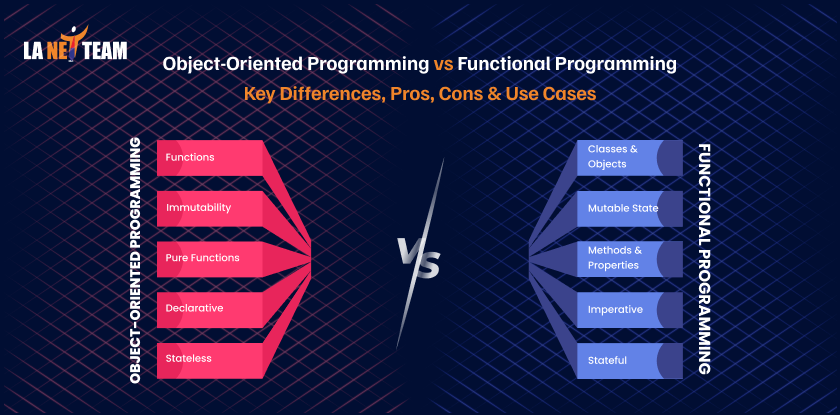
Object-Oriented programming vs. functional programming are two basic ways to write and organize code. They fall under programming styles, also called programming paradigms. Understanding them is important because it decides how your code is structured, how easy it is to change, and how well it works as the project grows.
Both are the most common differences developers ask when choosing how to design software. Knowing the difference helps you choose the right approach for your projects instead of copying others.
What is Object-Oriented programming (OOP)?
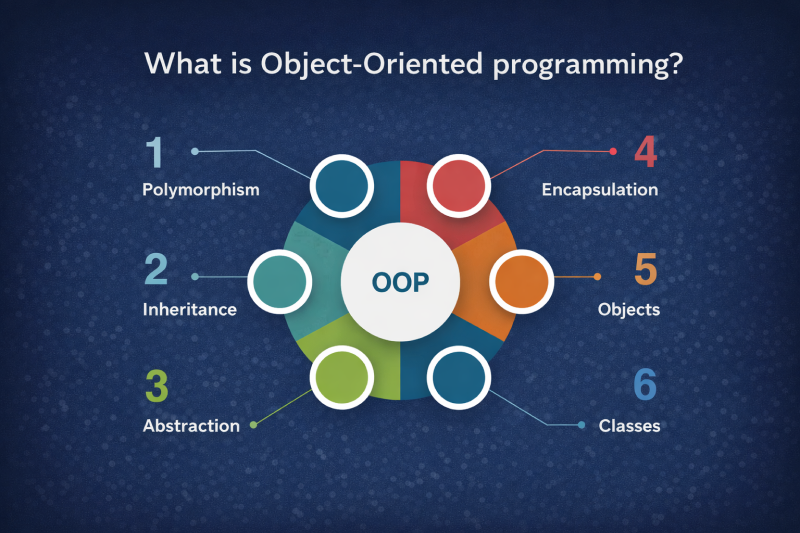
Object-oriented programming is a way to write software by thinking in terms of real-life things. Instead of writing one long list of instructions, you break the program into small parts called objects.
Each object:
- Represents something (like a user, car, or order)
- Stores information about it
- Performs actions
For Example:
Think of a mobile phone. It includes information such as its brand, battery level, and screen size. It can also do things, like make calls, send messages, or charge.
In Object-Oriented Programming, software works the same way. You create objects that store information and know what actions they can do, just like a real phone.
| Pros | Cons |
|---|---|
| Keeps important data protected and organized | Managing changing data becomes difficult in large systems |
| Allows code reuse instead of rewriting everything | Objects can depend too much on each other, reducing flexibility |
| Easier for beginners to learn and follow | Deep inheritance can make code hard to understand and change |
| Offers strong support with many tools and libraries | Shared data can make multitasking and parallel work harder |
What is functional programming (FP)?
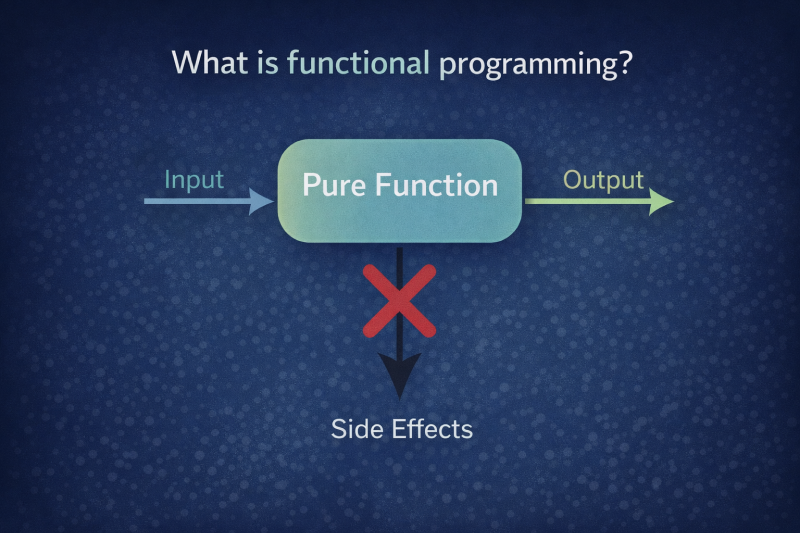
Functional Programming is a way of writing software that focuses on functions and data.
In FP, a function takes input, returns output, and doesn’t mess with anything else.
In simple terms, it helps you write code that is predictable, easy to test, and less prone to errors.
For example:
Let’s say you take a blender, where you put in fruits nd get a smoothie. The fruits are processed, but the kitchen counter stays the same. In functional programming, functions work like this, safe, predictable, and repeatable.
| Pros | Cons |
|---|---|
| Bugs are easier to find since errors stay within the function | Concepts like higher-order functions and recursion can be confusing for beginners |
| Pure functions are reliable and easy to test | Some real-world systems are harder to model than in OOP |
| Immutability allows safe parallel processing | Creating new data instead of changing existing data can use more memory |
| Higher-order functions make code concise and readable | Fewer libraries and smaller communities compared to OOP languages |
Key Differences: Functional Programming vs OOP (Object-Oriented Programming)
Functional programming and object-oriented programming are two major ways to write software.
They come from different ideologies, each one has its own approach to solving problems, organizing code, and handling data.
1. Focus of the paradigm
Functional programming focuses on functions and how data flows through them. It computes the result by evaluating mathematical functions and avoids changing the data directly.
Object-oriented programming focuses on objects that contain both data and behaviour. These objects interact to perform tasks.
2. How data is handled
In FP, data is immutable (it doesn’t change after it’s created). Functions take data in, return new data, and don’t modify the original.
In OOP, objects store data that can change over time through methods. This allows the state (the current condition of the object) to evolve.
3. Main Building Blocks
FP uses functions as its primary building blocks. Functions are designed to be pure, which means they only return a result based on input, with no hidden changes.
OOP uses classes and objects, where objects hold both data (attributes) and behavior (methods).
This difference shapes how you structure your code.
4. Modularity and reuse
In FP, you reuse code by combining small functions. Each function does one job, and you chain them together to create bigger logic.
In OOP, reuse of code happens by building on existing classes. You can create a new class from an old one, add new features, or rewrite everything without changing anything.
5. Execution model (how code runs)
FP follows a declarative model. It means you focus on what result you want, not the steps to get there. This makes code cleaner and easier to reason about.
OOP follows an imperative model. You clearly tell the system to do each step. The code runs in a specific order, with objects changing state as actions happen.
6. Side effects and predictability
FP avoids side effects, functions don’t change anything outside themselves. This makes the code clearer and easier to test.
OOP methods can change objects or the program state, which sometimes makes behavior harder to predict unless carefully managed.
7. Typical use cases
In Functional Programming, functions work in isolation. They take input, return output, and don’t change anything else. This makes the code predictable, easier to test, and easier to trust.
In Object-Oriented Programming, methods often update object data or shared state. This is powerful, but if not handled carefully, it can make the program harder to follow and debug.
Which one is better, object-oriented vs functional programming?
According to Stack Overflow surveys, most modern developers use both object-oriented & functional programming. Languages like JavaScript, Python, Java, and Kotlin mix both OOP and FP because real software needs structure and safety together.
Industry reality:
- OOP gives structure.
- FP gives safety and predictability.
- Mixing them gives the best results.
But still, the answer depends on what you are building and how you work.
OOP works best for large systems that look like the real world. Think banking apps, ecommerce platforms, ERP systems, or enterprise software.
Whereas, FP shines when you care about clean data flow, fewer bugs, and predictable behavior. This is why it’s popular in data-heavy and high-reliability systems.
Conclusion
At the end of the day, both Object-Oriented Programming and Functional Programming are just different ways to solve problems. One focuses on objects and structure, the other focuses on functions and flow.
If you like organizing things into classes and reusing logic, OOP will feel natural. If you prefer clean logic, fewer side effects, and predictable results, Functional Programming makes life easier.
There is no winner here. Many modern apps use a mix of both without even thinking about it. Choose the style that fits your problem and your brain. If the code is easy to read and easy to fix, you are already doing it right.