
What seemed like a ‘job replacement’ for developers has proven to be a powerful assistant for them.
AI code generators are widely used in the software world now. It is because of easy adaptability, learning along the process, that beginners can use it to create great features in software and more.
Developers are using AI to write, test, and review code. This reduces the operation costs, boosts speed, and frees up employee from routine works.
Around 82% of developers use AI coding assistants daily or weekly.
(Source: https://www.secondtalent.com/resources/ai-coding-assistant-statistics/)
What is an AI code Generator?
AI code generators turn natural language prompts into functional software code. They use large language models that are trained on vast amounts of code to predict and produce snippets, functions or entire applications.
AI in software development accelerates creation from idea to execution.
These systems operate via autocomplete, direct generation, or conversational interfaces embedded in IDEs like VS Code.
Give it simple instructions, and it does the magic.
How AI code generator work?
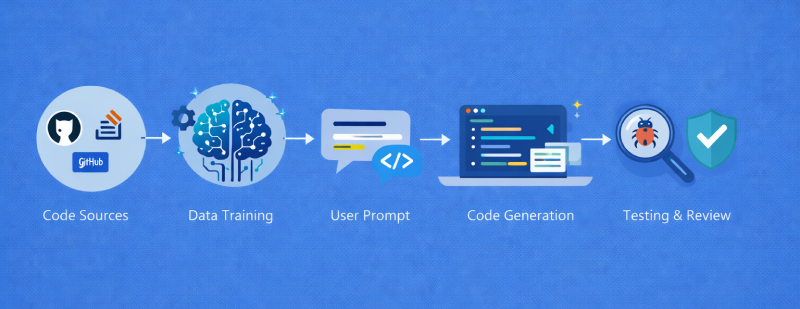
Step 1: Collecting Code Examples
What AI in application development does is collect and go through a lots of real code from websites like GitHub and Stack Overflow.
This builds a big collection of examples in different programming languages.
So, the AI is ready for anything that comes in the form of input from users.
Step 2: Cleaning the Code
The code, when in its raw form, is messy; the AI organizes it. Duplicate coding is removed, mistakes are fixed, and everything is sorted into useful pieces.
This makes the code clean and ready to learn from.
Step 3: Teaching the AI
These programs study the clean code to learn patterns, rules, and logic. They practice in guessing what comes next in code.
So, basically, it trains itself. So, the compatibility with every type of requirement is unmatched.
Step 4: Understanding What You Want
- Your Instructions: You give a simple or detailed request, like “make a login page using React” or show some partial code.
- Breaking It Down: The AI breaks your words into small pieces it can understand (like turning words into numbers).
- Checking Context: It also looks at things like your coding setup or past conversations to give you better results.
Step 5: Writing the Code
Now, it uses what it learned through the data. The AI writes matching code line by line.
It picks the best options based on millions of examples that it has studied.
Code suggestions appear instantly in your app, ready to use.
Step 6: Checking and Improving
You test, find bugs, fix mistakes, and make improvements. AI code looks good, but might have logic problems or security issues.
Final checks make sure it works, stays safe, and follows your rules.
Top 5 Tools for AI code generator in 2026
1. GitHub Copilot
GitHub Copilot is a renowned AI tool that helps you write code. It works with popular coding programs like Visual Studio Code, Visual studio, Neovim, and JetBrains.
It even suggests code that might help you finish what you are working on.
You can interact with it, ask questions about code, turn your code from one programming language to another, create tests, and clean up the messy code.
Features
- Suggests code as you type or writes it from plain English.
- Ask questions, fix bugs, and switch languages through built-in chat.
- Learns your project’s style by checking all your open files.
- Edit specific files or let it handle entire features independently.
2. Tabnine
Tabnine is a great AI code generator assistant that pushes on the software development by predicting the right ways, generating the correct codes, and completing the code.
It doesn’t learn from generic data, rather it understands your enterprise’s unique architecture, frameworks, and coding standards.
Tabnine gives centralized visibility, access controls, policy enforcement, and full auditability across users, teams, and workspaces.
Features:
- Keeps code private and secure, can run completely offline.
- Learns your company’s coding style and helps maintain team consistency.
- Built-in chat with the ability to switch between multiple AI models.
- Control what code it sees and personalizes to your style.
3. Google Cloud Code AI
It supports popular IDEs: VS code, JetBrains IDE, Cloud Workstations, and Cloud Shell Editor.
You get the Gemini code assistant to help you write the code faster. Easily test and debug apps on Google Cloud directly from your IDE.
It generates a code block based on comments. It reduces context switching, so it doesn’t break your workflow, and you have full attention.
Features:
- Real-time suggestions, generates functions from prompts, and includes chat assistant support.
- Integrated cluster management, GKE deployment, YAML linting with schema validation tools.
- Local debugging for GKE and Cloud Run with Skaffold real-time feedback.
- Simplified Cloud Run deployment, explore cluster resources, and integrate APIs seamlessly.
4. Claude
Claude’s latest update, Opus 4.6, has shaken the tech world. I used it, and it’s just WOW! Give any command, and it will give you output.
With that, the coding has become much easier. It enhances planning for complex tasks, sustains agentic workflows longer, and handles large codebases reliably.
A 1M token context window lets it manage massive projects without losing details. It has sped up multi-step coding from architecture to deployment.
Features:
- Automatically maps entire codebases, identifies project structure and dependencies in seconds.
- Coordinated changes across multiple files, ensures consistency in complex refactors.
- Runs in the terminal, executes commands, and tests with explicit user approval.
- Displays proposed changes as visual diffs in VS Code, JetBrains, and Cursor.
5. ChatGPT
It is one of the most powerful AI code generators, which lets developers create, debug, and optimize code from natural language inputs.
ChatGPT generates accurate, efficient code snippets across languages like Python and JavaScript, and requires very few modifications.
Studies have shown that it has high success rates of up to 93% on tasks like data analysis. The limitation comes in visual or graphic coding.
Features:
- Executes code securely, handles data uploads, generates plots, and debugs iteratively in chat.
- Create specialized coding assistants with uploaded codebases and docs for specific niches.
- Analyzes screenshots, UI designs, and handwritten notes to generate or fix code.
- Live browsing fetches the latest API docs, libraries, and examples for current frameworks.
Practical Applications of an AI Code Generator
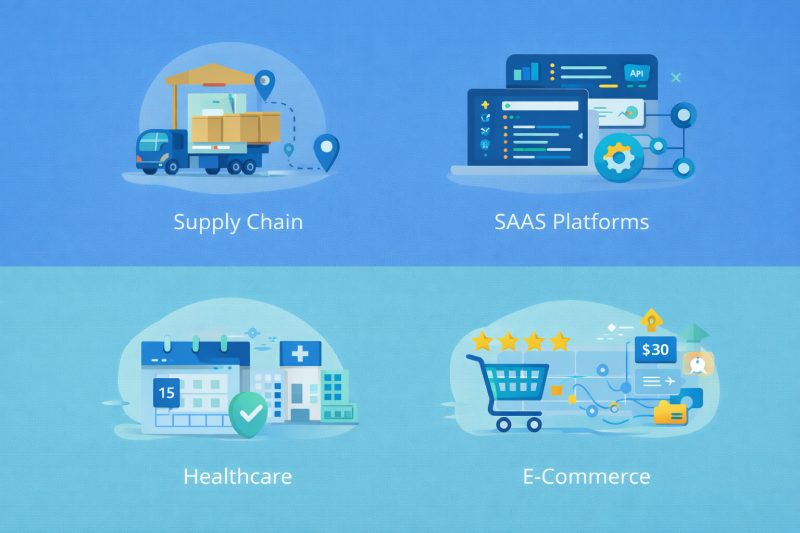
Supply Chain Tracking
One of the most used places of AI coding is in supply chain tracking. Global logistics giants use it to build real-time inventory management applications and intelligent route optimization systems.
Companies use AI to automatically script dashboard visualizations and automated alert systems that process continuous data feeds from warehouses, distribution centers, and delivery vehicles.
Monitor shipments, predict delays, optimize routes, and maintain inventory levels across different locations.
SaaS Feature Acceleration
SaaS providers offer customer relationship management and enterprise software that utilize AI code generation to rapidly prototype sophisticated user dashboards, API endpoints, and complex subscription billing logic.
The product teams conduct quick A/B testing experiments for onboarding flows and interactive analytics widgets.
Companies create better features faster, validate user preferences, and reduce time from development to launch.
Healthcare Workflow Automation
Modern hospitals and facilities use AI code generation to create tools that are useful for patients.
Create intelligent scheduling bots through simple natural language prompts.
Medical staff can automate routine administrative tasks, reduce patient wait times, optimize resource allocation across departments, and most importantly, improve care coordination.
E-commerce Personalization Engines
E-commerce is taking maximum benefits of AI in software development. They have enhanced the recommendation algorithms and dynamic pricing scripts.
Product teams test multiple variants with AI-generated backend logic, machine learning models, and database queries.
The retailers are able to personalize shopping experiences based on individual customer behavior.
Benefits of an AI code generator
Increased Productivity
Developers are now adapting AI, taking help from it in every step. Because it helps complete the tasks up to 55% faster by using AI to generate complete authentication systems in minutes.
Fewer Errors
AI-powered code generation finds syntax issues and suggests secure coding patterns. This helps reduce bugs that end up in production environments.
Teams spend less time and resources on debugging. Also, consistent code styles and formatting enhance code review efficiency and collaboration.
Cost Savings
Startups create minimum viable products faster on tight budgets. This helps even junior developers work more effectively.
Enterprise organisations can cut development cycles by up to 50%. This speeds up returns on software projects and lowers operational costs. It also helps with resource allocation for development teams.
Skill Boost
Less experienced developers get high-quality code templates and clear explanations. This helps them quickly build their technical confidence and skills.
AI code generation makes complex tasks easier for everyone.
Faster Market Delivery
Product prototypes and new features launch earlier than usual. This helps companies take advantage of new market trends and opportunities first.
A smooth CI/CD pipeline integration automatically creates full test suites and deployment scripts.
Conclusion
The AI code generator has been delivering exceptional results. For software, teams are using it as a co-worker that does all the routine work, checks through a lot of data, creates structure, and more.
With the advanced tools, the dependency on them has increased. Teams are implementing AI in every step to take advantage of it.
Thanks to the AI, the products are now becoming top-notch, speed has increased, and scalability has been achieved.
Using natural language to create prompts has made small companies profitable. They don’t have to spend a lot on hiring new employees.
In the near future, it has been predicted that 50% of the software works will be done by AI. It’s better to adapt as early as possible.