
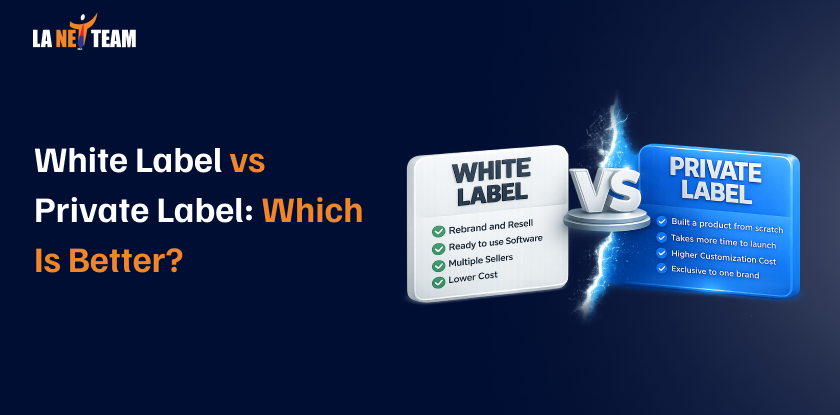
White Label vs Private Label are two different business models that let brands sell products made by someone else, but with key differences.
White label means selling a ready-made product under your brand. The product stays the same for everyone, only branding differs from company to company.
Private-label means creating a product exclusively for your brand, giving you more control over features, pricing, and positioning.
So, the question is which one is better? Let’s break down each model and get the answer to the question.
What is White Label Vs Private Label: Key Differences
If you want to start a product-based business, you have two shortcuts, White label and Private label.
If you choose the wrong one, you can end up wasting your time, money, and energy. Let’s break them down individually, so you can make a confident decision.
What is White Label?
White label means a company builds a ready-made product, and you sell it under your own brand name. You don’t create the product or manage development, you just have to focus on branding, pricing, and customers.
Example:
- Many agencies resell CRM systems built by platforms like Gohighlevel and Centripe.ai.
| Advantages | Disadvantages |
|---|---|
| You don’t need to build anything. | Others can sell the same thing |
| No need to manage factories and tech teams. | You can’t change much in the product |
| You don’t need big money to start. | You depend highly on the original company |
What is a Private Label?
Private label is when a product is made specifically for your brand, and only you can sell it under that name.
You work with the manufacturer to create the product. It may be based on an existing formula, but it is customized and exclusive to your brand.
Example:
- Amazon selling Amazon Basics.
- Costco sells Kirkland products.
These items are exclusive to their brands.
| Advantages | Disadvantages |
|---|---|
| No one else sells the same thing. | You need more money to start. |
| You can earn more profit per sale. | It takes more time to launch. |
| You build a strong brand over time. | You may need to buy stocks in bulk. |
| You can control pricing. | If it doesn’t sell, you will lose all the money. |
Difference between White Label and Private Label
Here is a side by side comparison that shows the actual changes over the other.
| Core Difference | White Label | Private Label |
|---|---|---|
| What is it? | Another company fully creates and owns the product. You simply resell it. | A manufacturer makes the product specifically for your brand. |
| Branding | You can add your logo and brand name. | You build the brand from the ground up, including packaging and positioning. |
| Exclusivity | Not exclusive. Many businesses can sell the same product under different names. | Exclusive to your brand. No one else can sell the same product under your name. |
| Customization level | Very limited. Usually logo, colors, and pricing. | More flexibility. You can change the design, features, ingredients, packaging, and more. |
| Control over product | Low control. The original company decides on updates and features. | Higher control. You can decide how the product looks and feels. |
| Investment required | Low upfront cost. Monthly subscription or licensing fees. | Higher upfront cost. You may need to invest in bulk production and inventory. |
| Long-term brand value | Harder to build strong brand loyalty since others sell similar products. | Strong brand-building potential because the product feels unique. |
Cost Comparison: White Label vs Private Label
When choosing between white label and private label, money is the biggest deciding factor.
Both models make it easier to launch a product. But the way you spend money in each model is very different. Let’s break it down in a simple way.
White label is cheaper to start. You usually pay $100 to $500 per month plus a small setup fee of $500 to $2,000. There is no inventory or manufacturing cost. Risk is lower because you can exit easily. Profit margins are usually around 10 to 30 percent.
Private label need more upfront money. You may invest $5,000 to $25,000+ for production, packaging, and bulk orders of 500 to 2,000 units. Your money is tied up in inventory, so risk is higher. But margins can be stronger, often 40 to 60 percent.
Which one to choose White Label or Private Label?
Let’s be practical…
If you don’t have a budget, a tech team, or months to wait, building your own product from scratch makes no sense.
Developing a product can alone cost $50,000 to $1,00,000 and take 6 to 12 months. That’s a big trap before you even get your first customer.
Therefore, choosing a white label makes more logical sense. As, instead of building, you plug into something that already works.
Conclusion
At the end of the day, white label and private label are just two different paths to the same goal. Building your brand faster.
White label is great when you want speed. The product is ready, you add your name, and start selling without headaches. Private label make sense when you want more control. It takes more effort but gives you a stronger identity.
There is no perfect choice here. Pick what fits your budget, timeline, and patience level. Just remember, customers care less about how you built it and more about how well it works for them.