

AWS vs Azure, two names you hear everywhere when people talk about cloud computing. Some people swear by AWS. Others say Azure is better.
And the numbers are real: as of 2025, AWS holds around 32% of the global cloud market, while Azure follows with about 23%.
So yeah, it’s a big debate, and it’s only getting louder as we head into 2026.
But here’s the simple truth: both AWS and Azure help companies run apps, store data, and scale without owning physical servers. The real question is which one fits your needs best.
In this guide, we’ll explain AWS vs Azure in plain, everyday language, so you can decide with confidence, not confusion.
What’s the real difference between AWS vs Azure?
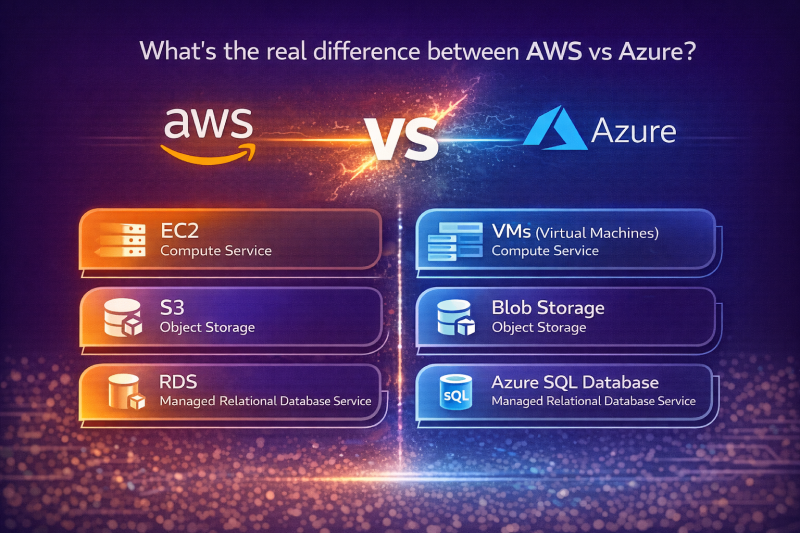
At the highest level, AWS (Amazon Web Services) and Microsoft Azure are cloud platforms that let you run apps, store data, and build digital products without owning data centers. But they got here differently, and that shapes what each does best.
What is AWS?
AWS (Amazon Web Services) is Amazon’s cloud platform that started in 2006. It lets businesses rent computing power, storage, and tools over the internet instead of buying servers.
AWS is the largest cloud platform today. It offers the widest range of services, strong global coverage, and high flexibility, which is why many startups and enterprises rely on it.
What is Azure?
Azure (Microsoft Azure) is Microsoft’s cloud platform. It helps businesses run applications, store data, and manage servers on the cloud.
Azure stands out because it works seamlessly with Microsoft tools like Windows Server, SQL Server, and Microsoft 365. This makes it a natural choice for companies already using Microsoft systems and moving them to the cloud.
Here’s a simple way to look at it:
- AWS gives you a lot of freedom to build anything from scratch.
- Azure feels familiar if you already use Microsoft tools.
That one difference shapes how easy the cloud feels, how much it costs, and how fast teams can move.
Who’s Actually Winning the AWS vs Azure Market Battle?
Both platforms are huge, but one clearly has the edge in size, at least as of recent data.
According to cloud market reports:
- AWS leads the market with about 30% of the global cloud infrastructure market share.
- Azure comes next with around 20–24%.
- Other players, like Google Cloud, share the remaining market.
What does this mean in simple terms?
- AWS is still the most used cloud, especially for startups and global SaaS products.
- Azure is growing rapidly, particularly among enterprises and in hybrid cloud solutions.
How do AWS vs Azure Pricing Models Actually Work?
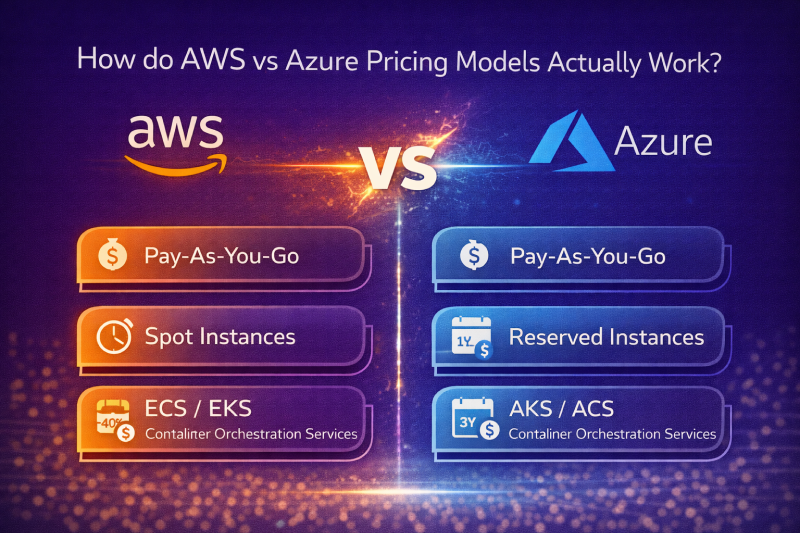
This question takes a major role in decision-making while choosing any cloud platform, because pricing is where most people get confused. On paper, both AWS and Azure look affordable. In real usage, costs depend on how smartly you use the cloud.
Let’s break it down in a simple, practical way.
The Pay as You Go Model
Both AWS and Azure follow a pay-as-you-go model. This means you only pay for what you use.
- AWS charges per second or per hour, depending on the service.
- Azure usually charges per minute and offers strong cost visibility tools.
This model works well if your usage changes often. But if you leave resources running without tracking them, costs can rise quickly.
The Costs That Actually Impact Your Cloud Bill
1. Free Tier and trial Credits
Both platforms allow you to test their services before spending real money.
- AWS offers a 12-month free tier and some services that are always free.
- Azure provides 200 dollars in credits for the first month, along with 12 months of free
This is great for learning and small experiments. It is not enough for long-term or production workloads.
2. Reserved Pricing for Long-Term Use
If you know your workload will run for months or years, reserved pricing can save a lot of money.
- AWS offers Reserved Instances and Savings Plans, with discounts going up to 70 percent.
- Azure offers similar reservations and adds Azure Hybrid Benefit, which is a big advantage if you already own Windows or SQL licenses.
This is where enterprises usually save the most.
3. Spot and low Priority Instances
For workloads that can handle interruptions, both platforms offer heavy discounts.
- AWS Spot Instances
- Azure Spot or Low Priority VMs
These can be much cheaper, sometimes up to 90 percent less. But they can stop anytime, so they are best for testing, batch processing, or background jobs.
Which Cloud has Better Services: AWS vs Azure Feature Comparison?
Choosing a cloud platform is not just about price. It’s about what you can actually build and how easily you can run it. This is where most teams get stuck.
Both AWS and Azure offer hundreds of services, but they don’t feel the same when you use them. Some tools are easier, some are more powerful, and some work better depending on your setup.
Let’s break down which cloud has better services in the AWS vs Azure feature comparison, in a way that actually helps you decide.
| Area | AWS | Azure |
|---|---|---|
| Compute | ✓ More VM options ✓ High flexibility |
✓ Best for Windows apps |
| Serverless | ✓ AWS Lambda | ✓ Azure Functions |
| Storage | ✓ S3 (industry leader) | ✓ Blob Storage |
| Databases | ✓ RDS, DynamoDB | ✓ Azure SQL, Cosmos DB |
| AI & ML | ✓ Strong customization | ✓ Easier to adopt |
| Hybrid Cloud | ✗ Limited | ✓ Very strong |
| DevOps Tools | ✗ Steeper learning | ✓ More unified |
| Security & Compliance | ✓ Very strong | ✓ Very strong |
| Identity Management | ✗ More setup | ✓ Built-in with AD |
Final Thoughts
When comparing AWS vs Azure, there is no universal winner. The right choice depends on your:
- Current tech stack
- Future roadmap
- Team’s skill level
- Budget and governance needs
AWS is the go-to if you want flexibility, scale, and a mature developer ecosystem.
Azure is best if your world is already built on Microsoft technologies or if hybrid cloud matters to you. The smartest teams don’t ask “Which is better?” They ask, “Which one solves our problems better?”
Both AWS and Azure will continue growing through 2026 and beyond. Your job as a decision maker is to pick the one that fits your business, not the one with the flashiest name.