
Angular vs React is a debate every growing tech team faces in 2026. Both frameworks power thousands of modern apps, from startups to global platforms.
In fact, recent developer surveys show React is used by over 40% of frontend teams worldwide. While Angular continues to dominate large enterprise projects with strong structure and long-term support.
The real challenge is not which one is “better.”…… Instead, which one is right for you?
That’s why choosing between Angular and React isn’t a trend decision. It’s a business decision.
Let’s break it down clearly, without hype, so you can choose what actually works in 2026.
Understanding the Fundamentals: Angular Vs React
Before diving into comparisons, it’s essential to understand what we’re actually comparing, because Angular and React aren’t quite the same type of technology.
What is React?
React is a JavaScript library specifically designed for building user interfaces. Developed and maintained by Meta (formerly Facebook) and released as open-source in 2013, React focuses primarily on the “view” layer of web applications.
What makes React particularly interesting is its philosophy of being “just JavaScript.” It doesn’t impose strict rules about how you should structure your entire application.
React 19, the latest major version in 2026, brings major upgrades to how apps work and feel. It now supports Server Components, concurrent rendering, and better automatic batching, making React apps faster and smoother than ever.
What is Angular?
Angular is a complete, opinionated framework for building web applications. Developed and maintained by Google’s Angular team, the current Angular (often referred to as “Angular 2+” to distinguish it from the original AngularJS) was completely rewritten and released in 2016.
Unlike React, Angular provides a comprehensive solution that includes everything you need to build a full-featured application.
Angular is built with TypeScript from the ground up, which adds static typing to JavaScript. This means you can catch errors during development rather than at runtime, making your code more reliable and maintainable.
The framework follows the Model-View-Controller (MVC) architectural pattern, providing clear separation of concerns and promoting organized code structure.
Angular vs React: Comparing How Both Frameworks Think and Work
Both Angular and React solve the same problem, but they think and work in completely different ways.
Understanding this difference helps you pick the right tool for your next project.
| Feature | React | Angular |
|---|---|---|
| Best For | Flexible projects where developers prefer custom tool choices. | Large, enterprise-level apps needing strict structure and consistency. |
| Core Philosophy | The library focused on UI components, giving freedom to choose tools. | Full-fledged framework with strict structure and guidelines. |
| Architecture Style | Component-based with one-way data flow. | Modular architecture using NgModules. |
| Data Binding | One-way data binding through props; clear and predictable. | Two-way data binding; UI and data stay in sync automatically. |
| Communication Between Components | Parent-to-child via props, child-to-parent via callbacks. | Uses @Input and @Output decorators for communication. |
| State Management | Multiple options: Redux, Zustand, React Query, Context API. | Built-in services and dependency injection for managing data and logic. |
| Learning Curve | Flexible but can overwhelm beginners due to many choices. | Steeper at first, but consistent structure makes large apps easier. |
| Component Types | Functional components with Hooks (useState, useEffect, etc.). | Decorator-driven components with metadata (e.g., @Component). |
| Routing | Not included by default; popular option is React Router. | Full built-in routing system with guards, modules, and lazy loading. |
| Templates | JSX (JavaScript mixed with markup). | Enhanced HTML templates with binding syntax. |
| Code Organization | You choose your own structure and tools. | Strong conventions; Angular apps feel similar across projects. |
Real-World Use Cases: When To Choose Angular Vs React
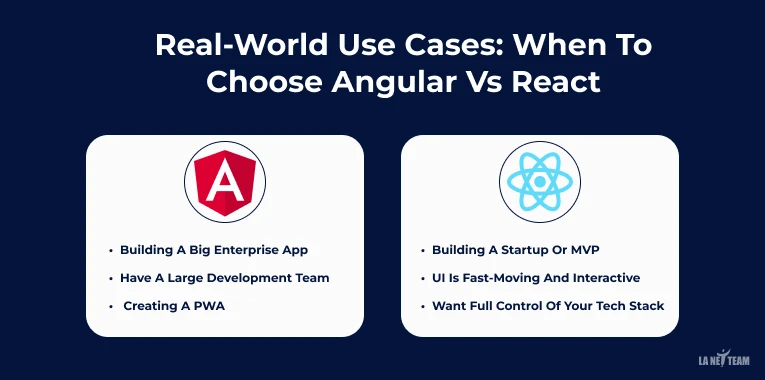
Understanding when to use Angular versus React based on real-world scenarios helps make the decision concrete rather than theoretical.
Choose React When…
1. You’re building a Startup or MVP
React helps you ship fast. It’s flexible, easy to learn, and great for quick changes. Tools like Next.js make it even faster to build.
2. Your UI is fast-moving and interactive
Live feeds, chats, dashboards, and social apps run smoothly with React. Big names like Facebook, Instagram, and Netflix use it for this reason.
3. You want full control of your tech stack
Pick your own routing, state management, and tools. React lets you choose everything based on your project’s needs.
4. You’re building for web and mobile
React Native makes it easy to share knowledge and sometimes code between platforms. It’s used by Uber, Shopify, and Discord.
5. Your team thinks “frontend-first.”
React developers focus on UI. If your team likes experimenting with new tools and patterns, React fits well.
6. You need SEO and server-side rendering
Next.js gives you fast load times and strong SEO support with SSR, SSG, and ISR.
Choose Angular When…
1. You’re building a big enterprise app
Angular gives you structure and consistency. Ideal for complex apps with many moving parts. Used by Google, Microsoft, and banks.
2. You have a large development team
Clear rules and patterns mean everyone writes code the same way. This reduces confusion and speeds up onboarding.
3. You’re creating a PWA
Angular has ready-made tools for offline mode, caching, and push notifications. Great for large consumer apps.
4. Your project will last for years
Angular’s stability, updates, and strong TypeScript support make long-term maintenance easier.
5. Your app is heavy on forms
Angular’s built-in forms (template or reactive) handle validation, errors, and complex logic without extra libraries.
6. You want an all-in-one framework
Routing, forms, HTTP, testing, and animations are all included. No need to search for third-party packages.
Conclusion
Choosing between Angular and React isn’t about picking the “perfect” framework. It’s about choosing the one that fits the way you work.
If you want speed, freedom, and a lighter learning curve, React will feel natural. Whereas, if you want structure, long-term stability, and a full toolbox in one place, Angular will have your back.
As you work, you’ll quickly see which one matches your thinking and your project needs.
Every great developer learned by trying, failing, and improving. Keep at it, and the right framework will reveal itself as you grow.